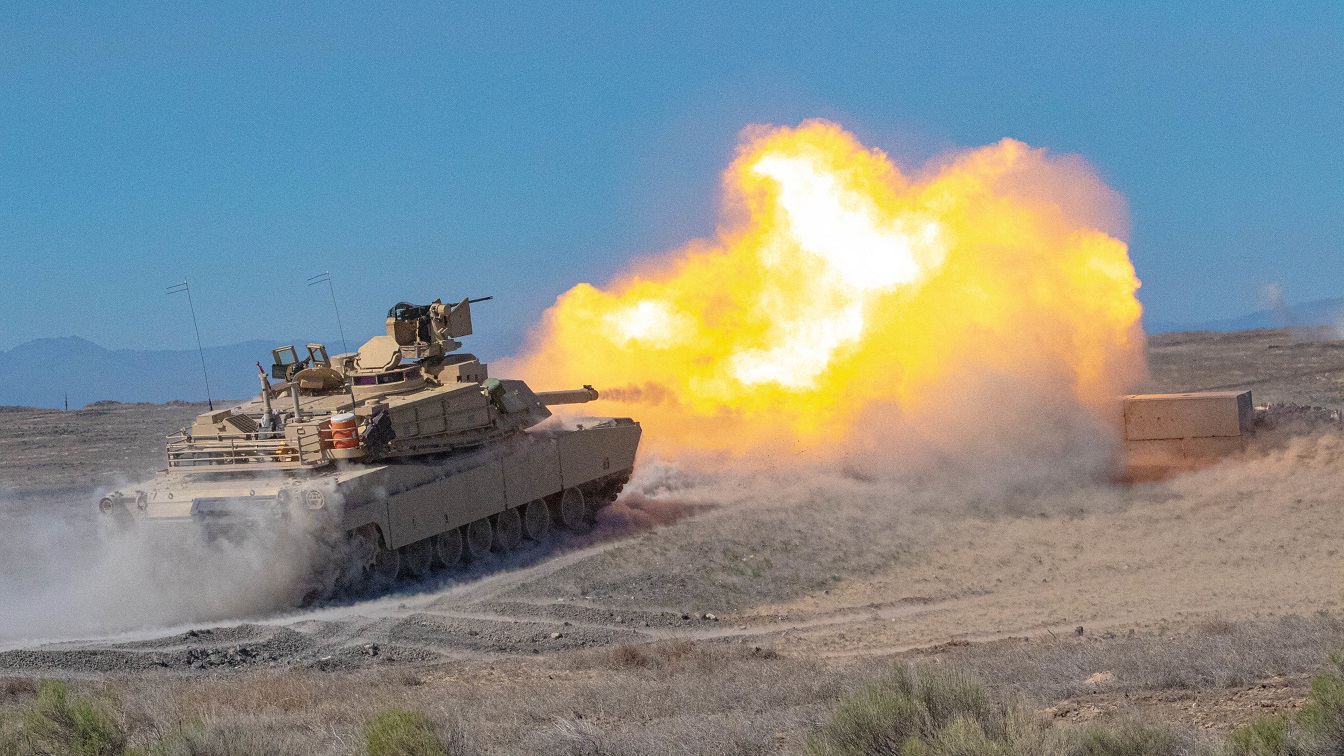
Current vehicle protection systems are designed to keep external threats out. They were never designed to handle what builds up inside, or what gets sucked in. Propellant combustion gases, vehicle exhaust ingested through air intakes, hydraulic fumes, fuel vapors, and weapons byproducts accumulate in sealed crew compartments with every engagement. The documented effects (headaches, nausea, impaired coordination, cognitive degradation) don't just compromise crew health. They directly limit how long and how hard a platform can fight.
The U.S. Army's own operational testing of the M109A7 Paladin howitzer tells the story plainly: maximum rate of fire is 8 rounds per minute; sustained rate drops to 1 round every three minutes. During testing, all 28 crew members showed symptoms of toxic fume exposure and the entire test was suspended.1 The M1 Abrams tells a similar story: cyclic rate exceeds 10 rounds per minute, sustained rate falls to 5–7.2 For submarines and naval vessels, toxic gas accumulation during prolonged sealed operations is a documented chronic problem the Navy has been managing, imperfectly, since the 1960s. For the Bradley IFV, the Army delayed its newest variant after turret batteries discharged toxic fumes into the crew compartment during testing.
The operational urgency is documented and current. In active combat theaters, artillery barrels designed for months of service are burning out in days under sustained fire rates, overwhelming spare parts pipelines and leaving more platforms out of action from parts shortages than from enemy fire.3 Our system targets exactly the air quality gap responsible, with the objective of extending sustained operational capability and keeping more crews in the fight.
The same principle applies in medical environments. Hospital-acquired infections affect an estimated 1 in 31 patients on any given day in the U.S. alone, with airborne pathogens a primary vector, and standard HVAC and HEPA filtration acknowledged by the CDC as insufficient to eliminate them.4 AirShield's molecular destruction approach addresses what filtration cannot.
Our AirShield system uses a dielectric barrier discharge plasma field to destroy airborne chemical and biological contaminants at the molecular level in real time. Not capturing them. Destroying them. Deployed alongside existing protection systems, it handles what they cannot.
Used in combination with our Photocatalytic Antimicrobial Coating (PAC), AirShield creates a complete air-and-surface sanitation environment: one actively destroying airborne threats, the other continuously neutralizing what reaches surfaces.
- Destroys toxic gases, propellant byproducts, fuel vapors, VOCs, and biological agents at the molecular level
- Up to 6-log (99.9999%) reduction of biological and chemical airborne hazards
- Washable, reusable electrostatic filters - no consumables, no supply chain dependency
- Complements existing vehicle protection systems - not a replacement, an enhancement
- Scalable: vehicle cabin units through naval, aviation, and industrial installations
- Applications: armored vehicles, aircraft, submarines, field hospitals, industrial facilities, residential and commercial buildings
1 U.S. Army DoT&E - M109A7 IOT&E Report
2 Military sources - M1 Abrams Rate of Fire
3 Grosswald.org - German Weapons in Ukraine: Barrel Wear Data
4 U.S. CDC - Hospital-Acquired Infection Statistics